Overview
A reverisible transformation of a thermodynamic in equilibrium, is a transformation that can be reversed. As a practical matter, a transformation can only be reversible if it is infinitesimally small and slow. That is, the state, starting from equilibrium must be smoothly moved to a new state of equilibrium that is close to the original state.
A reversible transformation can then be constructed as the sum of these infinitesimal transformations. Note, the assumption here is that the state reaches equilibrium after each infinitesimal transformation, before the next transformation occurs.
As a simple example, an ideal gas at equilibrium in a box can be transformed, by slowly changing the volue of the box. That is, if one of the walls if movable, one could move the wall a small amount, let the system reach equilibrium, then move the wall another small amount and so on.
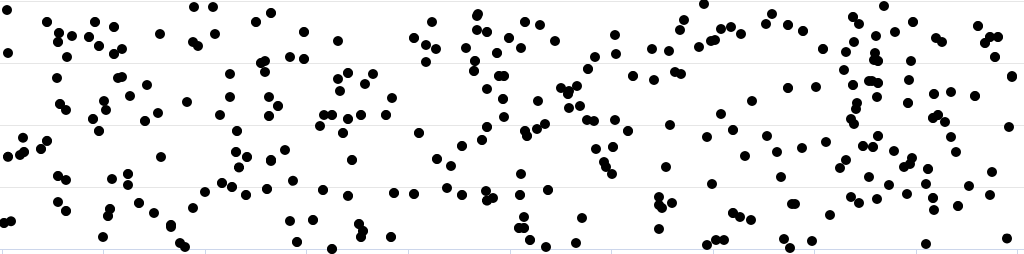
Particles at equilibrium in a box, with a movable wall, undergoes an infinitesimal transformation as the wall
is moved out.
Work
As a thermodynamic system is moved from one state to another state an infinitesimal distance away, the total work done by the system is given by
{% dW = P dV %}
This can be
integrated
to get the total work done.
{% \Delta W = \int P dV %}